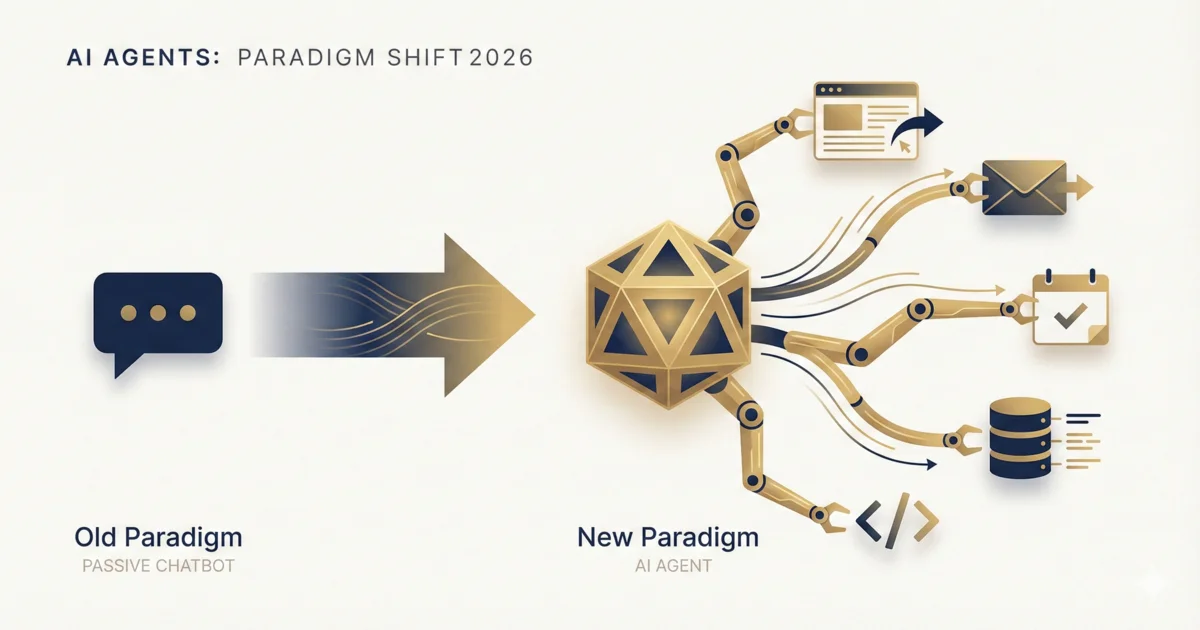
2026 marks a paradigm shift in AI usage: From reactive chatbots to autonomous agents. OpenAI, Anthropic, Google, and Microsoft are investing heavily in “Agentic AI” – AI systems that don’t just answer but act independently.
This article explains what AI Agents technically are, which applications already work today, and what companies should prepare for.
What Are AI Agents?
An AI Agent is an AI system that:
- Understands goals (natural language instructions)
- Creates plans (breaks tasks into subtasks)
- Uses tools (APIs, applications, browser)
- Acts autonomously (without human intermediate steps)
- Processes feedback (learns from results)
| Chatbot (GPT, Claude) | AI Agent |
|---|---|
| Answers questions | Executes tasks |
| Reactive | Proactive |
| Single interaction | Multi-step processes |
| User leads | Agent leads |
Example:
| Chatbot Request | AI Agent Request |
|---|---|
| ”How do I write a cancellation email?" | "Cancel my newspaper subscription” |
| Provides template | Finds contract data, writes email, sends it |
The Technical Architecture
AI Agents are based on four components:
┌────────────────────────────────────────────┐
│            Language Model (LLM)            │
│  (Claude Opus 4.5, GPT-5.2, Gemini 3, Llama) │
├────────────────────────────────────────────┤
│           Planning Module                   │
│    (Task decomposition, prioritization)    │
├────────────────────────────────────────────┤
│              Tool Use Layer                 │
│    (API calls, browser, file system)       │
├────────────────────────────────────────────┤
│              Memory System                  │
│    (Context, learning history, preferences)│
└────────────────────────────────────────────┘
Model Context Protocol (MCP)
Anthropic has established MCP as a standard for communication between AI and external systems. A practical implementation of this protocol is Moltbot – a local AI agent for SME automation. The protocol enables:
- Standardized interfaces to applications
- Secure credential management
- Controlled permissions
- Audit logs for compliance
Current Developments by Provider
Anthropic (Claude)
Claude has the most comprehensive agent infrastructure with “Computer Use” and the Agent SDK:
| Feature | Availability |
|---|---|
| Computer Use (Browser/Desktop) | Production since 2024 |
| MCP Protocol | Production, industry standard |
| Claude Agent SDK | Production |
| Claude Cowork (GUI for Agents) | January 2026 |
| 1M Token Context Window | Production (Sonnet 4/4.5) |
OpenAI
OpenAI has released “Operator” – a complete browser agent:
| Feature | Availability |
|---|---|
| Operator (Browser Agent) | Production since January 2025 |
| Computer-Using Agent (CUA) | Foundation for Operator |
| GPT-5.2 with Tool Use | Production |
| o3/o4-mini Reasoning | Production |
| Assistants API with Tools | Production |
Microsoft (Copilot)
Microsoft integrates agents into the Microsoft 365 platform:
| Feature | Availability |
|---|---|
| Copilot for Microsoft 365 | Production |
| Copilot Studio (Custom Agents) | Production |
| Autonomous Agents | Announced |
Google (Gemini)
Google develops agents primarily for Google Workspace integration:
| Feature | Availability |
|---|---|
| Gemini in Workspace | Production |
| Vertex AI Agent Builder | Production |
| Autonomous Agents | Development |
Use Cases for SMBs
1. Automated Email Triage and Response
Input: "Process my emails"

Agent:
→ Connects to email server
→ Categorizes incoming messages
→ Responds to standard inquiries automatically
→ Creates tasks for complex requests
→ Reports summary
Prerequisites:
- Clear categorization rules
- Defined response templates
- Whitelist of trusted senders
2. Research and Report Creation
Input: "Create a competitive analysis for our CRM module"

Agent:
→ Researches competitor products
→ Extracts pricing and features
→ Compares with own product
→ Creates structured report
→ Formats as presentation
3. Data Extraction and Processing
Input: "Process incoming invoices"

Agent:
→ Scans email inboxes
→ Extracts invoice data (OCR + LLM)
→ Validates against order database
→ Creates accounting export
→ Archives original documents
Risks and Control Mechanisms
Risk: Unintended Actions
Language models interpret instructions. “Clean up my inbox” can lead to deleted emails.
Countermeasure: Confirmation required for critical actions
confirmation_required:
  - email_delete
  - file_delete
  - payment_send
  - system_configure
Risk: Prompt Injection
External inputs (emails, documents) can contain hidden instructions.
Countermeasure: Input sanitization and sandboxing
Risk: Loss of Control
When chaining multiple agents, system behavior can become unpredictable.
Countermeasure:
- Limit action chains
- Audit logging of all actions
- Human-in-the-loop for critical paths
Implementation Recommendations
Phase 1: Observe (Weeks 1-4)
| Activity | Goal |
|---|---|
| Document processes | Identify automation candidates |
| Evaluate tools | Choose suitable agent platform |
| Risk assessment | Separate critical vs. non-critical processes |
Phase 2: Pilot (Weeks 5-12)
| Activity | Goal |
|---|---|
| Implement one use case | Gain experience |
| Establish control mechanisms | Ensure security |
| Define metrics | Make success measurable |
Phase 3: Scale (from Month 4)
| Activity | Goal |
|---|---|
| Additional use cases | Gradual expansion |
| Training | Enable employees |
| Governance | Establish guidelines |
Conclusion
AI Agents are not a future vision – they are usable today. The technology is mature enough for productive applications, but not yet mature enough for blind trust.
The smart approach: Deploy in a controlled manner, monitor closely, expand gradually. According to current surveys, 72% of large enterprises already deploy autonomous agents for operations, customer support, and software testing.
2025 was the year of Agents. 2026 is the year of “Agent Harnesses” – the infrastructure that orchestrates agents reliably over long periods. The question is no longer whether AI Agents are coming – but whether you’re prepared.
Frequently Asked Questions
Do AI Agents replace employees?
Short-term, no. Agents take over repetitive subtasks, not complete roles. They shift work from routine to supervision and exception handling.
How secure are AI Agents?
As secure as you configure them. Without controls, they’re a security risk. With thoughtful setup (sandboxing, permissions, audit), they’re manageable.
Which platform is recommended?
For self-hosting and data privacy: Claude Opus 4.5 with MCP. For Microsoft environments: Copilot. For browser automation: OpenAI Operator (available since January 2025 for Pro users).
What does getting started cost?
A pilot project is achievable from €5,000-10,000 (licenses, configuration, training). Running costs depend on volume – typically €0.01-0.05 per agent action.
Want to evaluate AI Agents for your company? In a free consultation, we analyze suitable use cases and develop a secure implementation plan.